Food · Sushi
Conveyor-Belt Sushi: How Tokyo Actually Eats Sushi
The sushi in your head — a hushed counter, a stern master, a ¥30,000 bill — is real, but it is not how most Tokyoites eat sushi. We eat it at kaiten-zushi: bright, family-friendly conveyor-belt restaurants where you order on a touch screen, plates arrive in seconds, and a genuinely good meal runs ¥1,000–2,500 a head. Here's exactly how it works, so you can walk in like you've done it a hundred times.
There are two sushi worlds in Tokyo, and travel media only ever shows you one. The first is the omakase counter: ten seats, a chef who trained for a decade, no menu, and a bill that can pass ¥30,000 a person. It's a wonderful experience — and most locals do it once a year at most, if ever.
The second world is where Tokyo actually eats sushi on a normal Tuesday: kaiten-zushi (回転寿司), conveyor-belt sushi. Families, students, salarymen, couples — everyone goes. It's fast, it's surprisingly good, the fish is fresher than the cheap price suggests, and you point at pictures instead of performing sushi etiquette you half-remember from a blog. If this whole site is about Tokyo at local prices rather than tourist prices, conveyor-belt sushi is the single clearest example of the gap.
What is kaiten-zushi, exactly?
What it is: a sushi restaurant where plates travel past your seat on a conveyor belt, and you take what you want — or, increasingly, order on a touch panel and have it delivered straight to you. You're charged by the number (and colour) of plates you stack up. It was invented in Osaka in 1958 by Yoshiaki Shiraishi, who reportedly got the idea watching beer bottles move along a brewery conveyor. It has been the everyday face of sushi in Japan ever since.
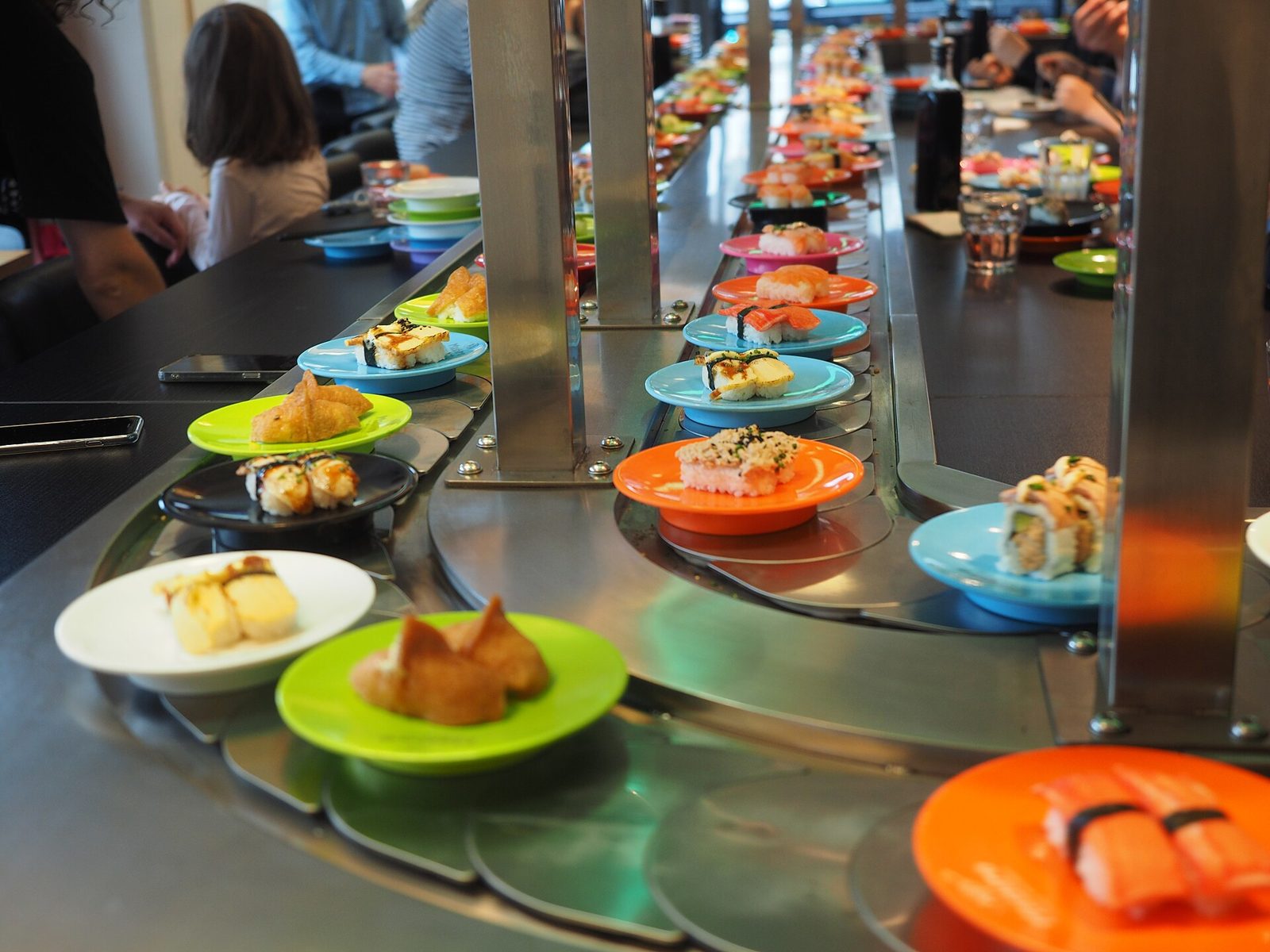
The important update for 2026: at the major chains, the spinning belt is no longer really the point. Most people now order on a multilingual touch screen, and the food arrives on a dedicated express lane in front of your seat. The romantic image of plucking random plates off a loop still exists, but think of modern kaiten-zushi as "sushi by tablet, delivered in 90 seconds." That's good news for visitors: you barely need to speak, and nothing is left to guesswork.
How it actually works, step by step
- 1. Get a ticket / check in. At the door there's usually a touchscreen kiosk. Tap your group size and counter-vs-table, take the printed ticket with your number, and wait for it to be called or shown on screen. Big chains also let you book ahead in an app to skip the wait (more below).
- 2. Sit down. Every seat has a tap for free green tea (powder in a pot + a hot-water spout), a box of chopsticks, soy sauce, and a touch panel or tablet.
- 3. Order on the panel. Switch it to English (or Chinese/Korean) in one tap. Browse photos, tap what you want, choose quantity, hit order. It arrives on the express lane right at your seat, usually within a couple of minutes.
- 4. (Optional) take from the belt. If plates are circulating, you may take any plate sitting in front of you. Don't take one, inspect it, and put it back — that's the one real taboo.
- 5. Stack your empties. Keep your finished plates at your seat; they're how you're billed. Some chains (Kura) have a slot that swallows plates and counts them automatically.
- 6. Pay. Press the "finish / bill" button on the panel; staff count your plates (or the system already has) and hand you a slip. Pay at the front register — cash always works; cards and IC cards usually do at the chains. (New to tap-to-pay here? See our Suica & PASMO guide.)
Reading the plates: colour = price
The genius of kaiten-zushi is that pricing is visual. Each plate colour or pattern is a price tier, shown on a chart at your seat. A standard plate (often around ¥120 for two pieces) looks different from a ¥300 premium plate, so your bill is literally stacked in front of you — no surprises. If you're budgeting, you can eat very well sticking mostly to the standard tier and adding a few premium plates of whatever you love.
The big four chains, decoded
Four national chains dominate, and each has a personality. We have a full guide to each — here's the one-line version:
- Sushiro — the nation's favourite. Japan's biggest chain, widely loved for the best balance of quality and price. The default "let's get sushi" answer for most families.
- Kura Sushi — the fun one. Every five plates you drop in the table slot triggers a gachapon game for a small prize — a hit with kids and first-timers. Strong additive-free positioning.
- Hama Sushi — the cheapest. The no-frills value king, with some of the lowest plate prices and frequent weekday deals. Pure bang-for-yen.
- Genki Sushi — the high-speed one. No circulating belt at all; you order by tablet and your plates rocket to you on a direct "bullet-train" lane. The central Shibuya branch is a tourist favourite for exactly this reason.
What to order (and a few visitor tips)
- Crowd-pleasers: salmon (sāmon), tuna (maguro), seared salmon (aburi sāmon), shrimp (ebi), egg (tamago), and the ever-popular negitoro (minced fatty tuna with onion). All usually sit in the cheapest tier.
- Not into raw fish? There's far more than sushi: karaage (fried chicken), fries, corn soup, chawanmushi (savoury egg custard), udon, and a serious lineup of desserts (the chains take cake and parfaits surprisingly seriously). Nobody will go hungry.
- Wasabi: chain plates are usually made without wasabi (sabi-nuki) by default; there's a tube at the table to add your own.
- Allergies / what's in it: the English panel lists items clearly, and the photo-based ordering means you always see what you're getting.
- Free stuff: green tea, water, soy sauce, pickled ginger (gari) and chopsticks are all complimentary and self-serve.
The three etiquette rules that actually matter
- Never return a plate to the belt. If you take it, it's yours. This is the one rule locals genuinely care about (hygiene rumours have made chains lean even harder on direct-order lanes).
- Don't drown it in soy sauce, and dip fish-side, not rice-side, if you want to look like you know what you're doing — but honestly, at a ¥120 chain nobody is judging.
- Keep your plates; don't bin them or hand them back early — they're your bill.
The honest local verdict: is conveyor-belt sushi "real" sushi?
Yes — with a caveat, and I'll be straight about it.
- Go (almost everyone should) if you want to eat sushi the way Tokyo families actually do: cheap, fast, genuinely tasty, zero stress, and a great window into everyday Japan. For value and ease it's unbeatable, and it's the most foreigner-friendly sushi in the city.
- Splurge on a counter instead if this is a once-in-a-lifetime sushi pilgrimage and you want the artistry — the rice temperature, the aged fish, the chef's sequence. That's a different (and far pricier) experience. For a middle path, an early-morning bowl at Toyosu Market or a sit-down meal at a reliable mid-range name like Sushi Zanmai gives you "proper" sushi without omakase prices.
My framing: conveyor-belt sushi is the everyday default, and it's brilliant at being exactly that. New to ordering sushi at all? Start with our how to eat sushi in Tokyo primer, then walk into any of the big four with confidence.
Practical information
Conveyor-belt sushi (回転寿司 / kaiten-zushi) — eating at the major chains
- Where: everywhere. Every major station district has at least one of Sushiro, Kura, Hama or Genki, usually in or near a shopping building. Search the chain name plus your area, e.g. "スシロー 新宿".
- Budget: plates from about ¥120 (two pieces); a filling meal usually ¥1,000–2,500 a person.
- Best times / waits: lunch (around 12–1) and dinner (6–8), especially weekends, mean real queues. Use the chain's app to take a numbered ticket remotely and arrive when your turn is near — a genuine local hack. Off-peak (2–5 pm) you usually walk straight in.
- Paying: cash always; most branches also take cards, IC cards (Suica/PASMO) and QR. (See our Suica & PASMO guide.)
- Language: touch panels switch to English, Chinese and Korean; ordering is photo-based, so language is barely a barrier.
If you remember only three things
- This is how Tokyo really eats sushi — cheap (¥1,000–2,500), fast, family-friendly, and far better than the price suggests.
- Order on the touch panel in English; the plates come to you, and the colour of each plate is its price.
- Never put a plate back on the belt — and use the chain's app to grab a ticket before you arrive at peak times.
Make your Tokyo food days easier
- A phone with data (eSIM). To switch the chain's app to English, take a remote queue ticket, and map the nearest branch, you'll want to be online from the moment you land. A travel eSIM for Japan activates before arrival — no airport queue.
- Want a local to lead the way? A small-group Tokyo food tour takes you past the famous names to the everyday spots most visitors never find.
These are affiliate links: they cost you nothing extra, and a small commission helps keep these guides free.
The local bottom line
If you only ever picture sushi as a solemn, expensive counter, you'll miss how Tokyo actually eats it — brightly lit, kid-friendly, ordered off a screen, and stacked up plate by colourful plate for the price of a sandwich back home. Conveyor-belt sushi isn't the budget compromise; for most of us it is sushi. Pick a chain, switch the panel to English, and eat like you live here.
Saved you from overpaying for sushi? If these guides help, a small tip keeps them coming.
☕ Buy me a coffeeImage credit: {c} (resized).
Not sure which chain or branch to pick?
Ask me directly — I reply in public so the next traveller benefits too: