Food · Ramen
Menya Musashi: Tokyo's Legendary Double-Soup Ramen
If Ichiran is the perfect first ramen, Menya Musashi is your confident second one. It's a piece of Tokyo ramen history — the shop that helped invent the rich "double soup" everyone copies now — and a chain where, unusually, every branch is different. Here's the local guide.
Once you've had your easy, foolproof first bowl, the natural next question is: where do locals go when they actually care about the ramen? One of the honest answers is Menya Musashi (麺屋武蔵) — a name serious Tokyo ramen people say with real respect. It isn't cheap and it isn't a quiet solo booth; it's a louder, richer, more characterful bowl with a genuine story behind it. Let me tell you that story, and then be straight with you about whether it's worth your money.
What is Menya Musashi, exactly?
What it is: a small, Tokyo-only group of ramen shops founded in 1996 that became one of the most influential names in modern Japanese ramen. The first shop opened in Aoyama, started by a former fashion-industry man, Takeshi Yamada, who wanted to build a ramen shop unlike anything that existed. It worked: Musashi is remembered as one of the "Class of '96" — three shops that opened that year and reshaped how Tokyo thinks about ramen.
The name comes from Miyamoto Musashi, Japan's most famous swordsman — a man who was self-taught, fought without a master, and is said to have never lost a duel. The founder chose it for exactly that spirit: independent, undefeated, doing it his own way. You'll feel that theme everywhere, from the kanji on the branch signs to the staff calling out as you enter.
The "double soup" — why this place matters
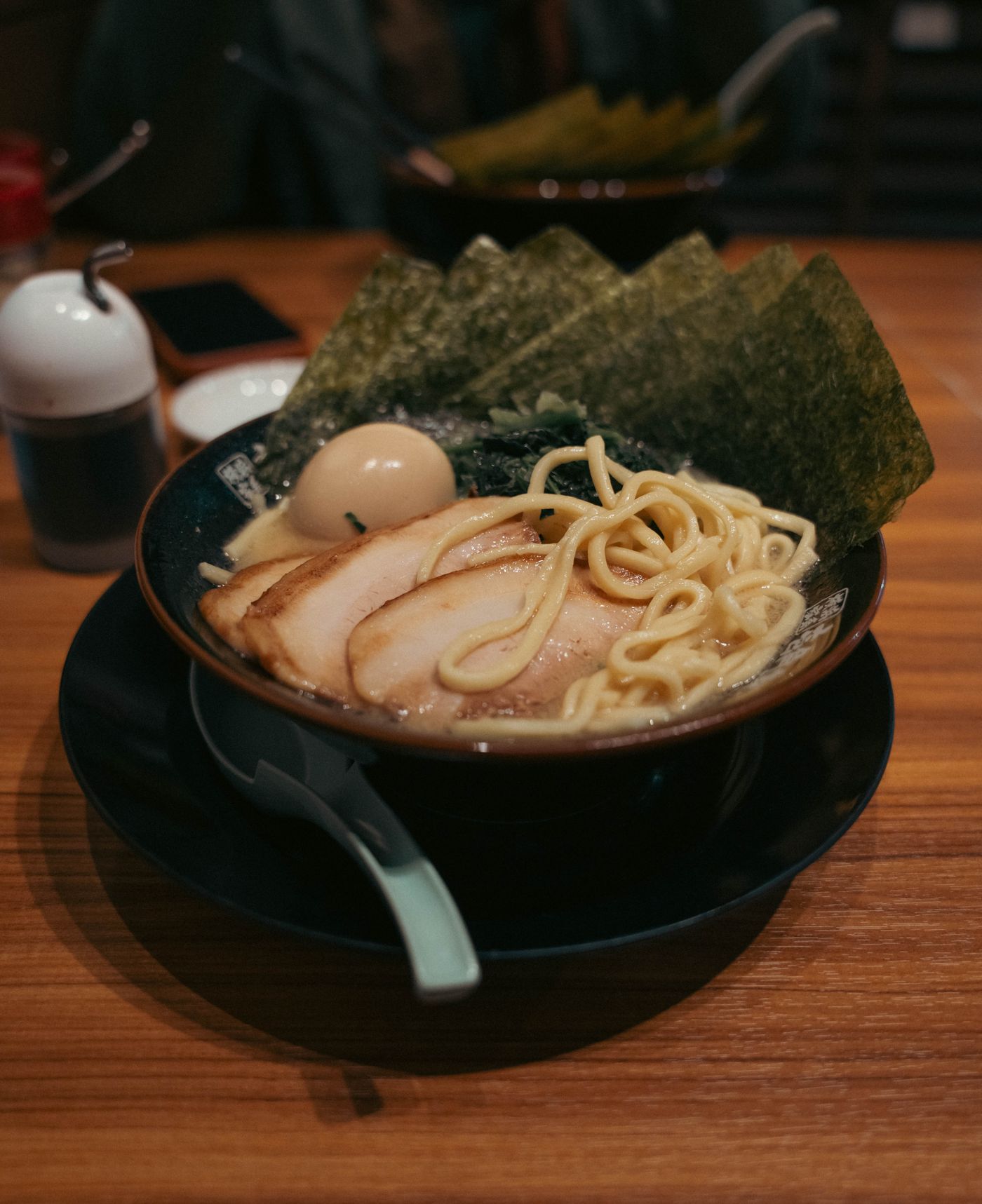
Here's the bit worth understanding, because it's Musashi's real claim to fame. In 1996, most ramen broth was one thing: pork-bone, or chicken, or soy. Musashi built its broth from two soups blended together — a rich animal-based stock (chicken and pork bones) married to a seafood stock drawn from bonito flakes and dried sardines (niboshi).
That "double soup" (Wスープ) — deep and meaty but with a savoury, almost smoky seafood backbone — was genuinely new at the time. Today you'll find that style all over Tokyo; Musashi is one of the places that started it. Eating here is a little like hearing the original of a song you've only known through covers.
Why every branch is different (this is the fun part)
Most ramen chains aim for the exact same bowl in every shop. Musashi does the opposite, and it's the single most interesting thing about going. There are only around fourteen branches, all in Tokyo — the company calls this its "never leaves the gate" policy and has deliberately never expanded to other Japanese cities. You have to come to Tokyo to eat it.
And each branch carries its own second name — a "double brand." The flagship is Soshi Menya Musashi in Shinjuku (it renamed itself from "Shinjuku Main Store" to Soshi, meaning roughly "the founding," as a return to its 1996 roots). Other branches go by martial, Musashi-themed names: Bujin, Bukotsu, Niten, Takatora, Kosho, and so on. Crucially, each shop's manager has real freedom over the menu, the flavour, even the prices. So two Musashi branches can serve genuinely different bowls. Going to a second one isn't repeating yourself — it's a new dish.
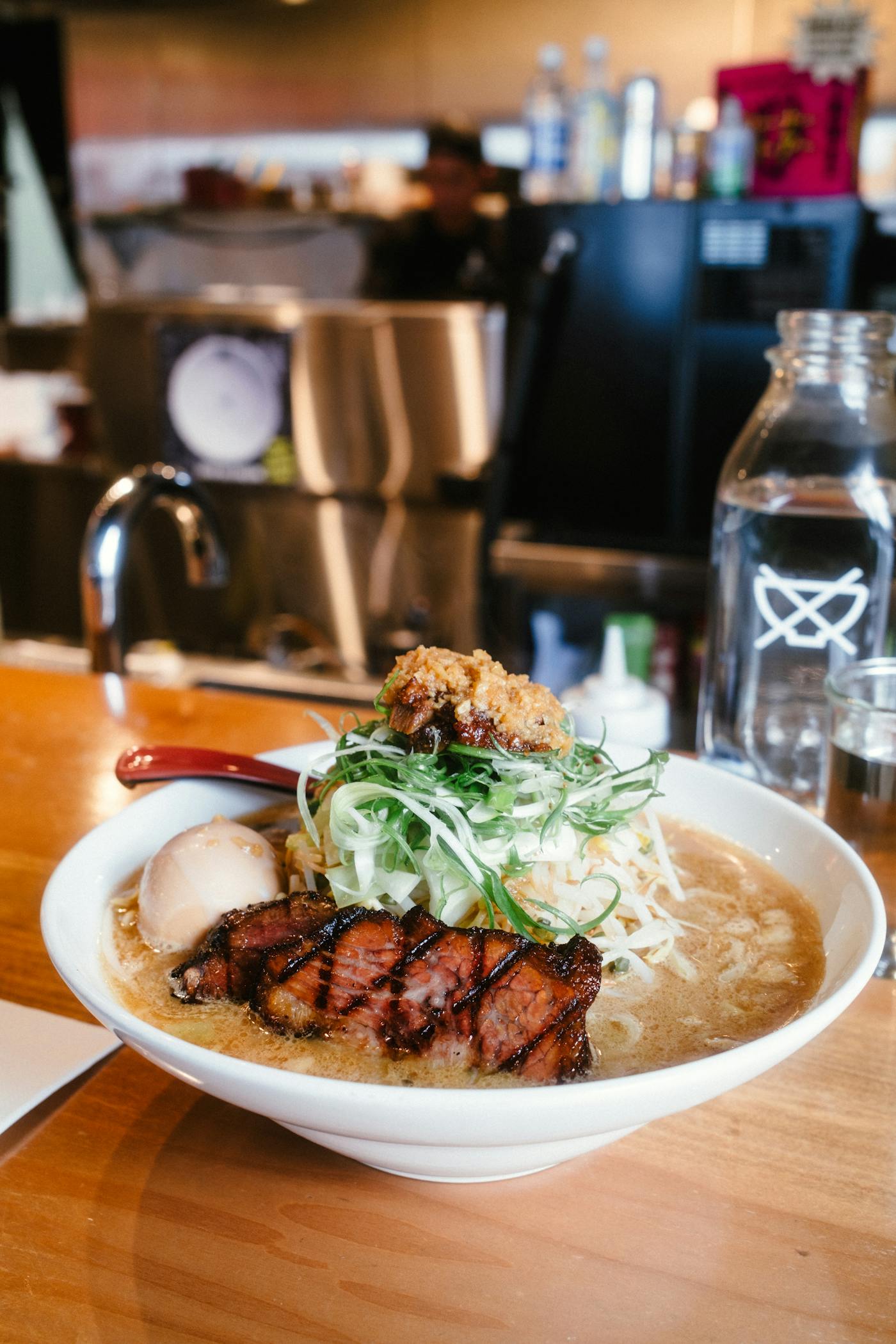
The local move: don't think of it as "a chain I've already tried." Think of each branch as its own restaurant that happens to share a bloodline. The Akihabara branch (Bujin), for instance, is famous for crowning the bowl with a single 100g-plus slab of soft braised pork — a different experience from the flagship.
What to order — and the value trick
Two main families to choose from:
- Ramen (ら~麺) — noodles in the hot double soup. The classic, around ¥1,030.
- Tsukemen (つけ麺) — noodles served separately to dip into a thick, concentrated broth. The rich tsukemen is the crowd favourite, around ¥1,080. Brilliant in warmer months.
Then there are the premium signature bowls — the ones piled with that thick slab (or two) of braised pork — running roughly ¥1,550, and about ¥2,000 for the double-meat version. Worth it once if you're hungry and want the full statement bowl; not the everyday choice.
How ordering works, start to finish
- Buy a ticket first. Most branches use a vending machine at the entrance — choose your bowl and any extras, pay, take the ticket. (Pick your free noodle size here if the machine offers it, or tell staff when seated.)
- Hand the ticket to staff and take your seat — usually a counter facing the kitchen, so you can watch the bowl being built.
- Eat it fresh. The double soup is at its best the moment it lands. For tsukemen, dip a few strands at a time rather than drowning them.
- Paying: the ticket machine takes cash, and many central branches also accept cards, IC cards (Suica/PASMO) and QR payments — but it varies by branch, so have some cash as backup. (New to IC cards? See our Suica & PASMO guide.)
- Timing: most branches run roughly 11 am to 10 pm, and the popular ones grow a queue at peak lunch and dinner. Go a little off-peak and you'll often walk straight in.
The honest local verdict: is it worth it?
Here's where I earn your trust. Menya Musashi is not a budget bowl, and it's a notch above what most of us pay day to day. But unlike some famous names, you're paying for something real: a distinctive, well-made bowl with genuine history, and the fun of branches that each do their own thing.
- Go to Musashi if you've had a ramen or two and want to level up — a richer, more characterful bowl with a story; you like the idea of a "famous original"; you're hungry enough to enjoy the free extra noodles; or you simply want a reliably excellent bowl near a major station.
- Skip it (for now) if you're counting yen hard. The city is full of neighbourhood shops doing a superb bowl for ¥750–900 — the everyday ramen locals actually eat most often, and exactly the spirit of our cheap-eats guide.
My honest framing: Ichiran (solo booth) and Ippudo (easy sit-down) are the on-ramps; Musashi is the first "destination" bowl worth crossing town for — and Mutekiya in Ikebukuro is the line-up classic for big-tonkotsu days. Have an easy one and a destination one early in your trip and you'll understand the range of Tokyo ramen far better than the average visitor ever does.
Where to find it: the Menya Musashi branches
True to its philosophy, every branch has its own name, its own twist, and often its own limited bowls — so each is worth treating as a restaurant in its own right. There are around fourteen, all in Tokyo; here they are by area (each name opens in Google Maps). Most run roughly until 9–10 pm and details change, so check before a special trip.
Shinjuku & Takadanobaba (near our Shinjuku guide)
- Soshi Menya Musashi (創始 — the flagship) — 7-2-6 Nishi-Shinjuku, Shinjuku-ku, Tokyo (Nishi-Shinjuku K-1 Bldg 1F)
- Gorindo (五輪洞) — 8-5-3 Nishi-Shinjuku, Shinjuku-ku, Tokyo (Watanabe Bldg 1F)
- Takatora (鷹虎) — 2-19-7 Takadanobaba, Shinjuku-ku, Tokyo
Akihabara & Kanda
- Bujin (武仁 — famous for its big braised-pork slab) — 2-18-5 Kanda-Sakumacho, Chiyoda-ku, Tokyo (Ark Bldg 1F)
- Gantora (巌虎) — 1-3-9 Sotokanda, Chiyoda-ku, Tokyo
- Kamiyama (神山) — 3-8-7 Uchikanda, Chiyoda-ku, Tokyo (Grand Forks Kanda Bldg)
Ueno & Okachimachi (near our Ueno guide)
- Bukotsu (武骨) — 6-7-3 Ueno, Taito-ku, Tokyo
- Bukotsu Soden (武骨相傳) — 6-11-15 Ueno, Taito-ku, Tokyo
Ikebukuro (near our Ikebukuro guide)
- Niten (二天 — takes cards) — 1-2-4 Higashi-Ikebukuro, Toshima-ku, Tokyo
Shibuya & Roppongi (Shibuya branch is near our Shibuya guide)
- Bukotsu Gaiden (武骨外伝) — 2-8-5 Dogenzaka, Shibuya-ku, Tokyo
- Kosho (虎嘯) — 4-12-6 Roppongi, Minato-ku, Tokyo (Uchida Bldg 1F)
Hamamatsucho & Shiba
- Hamamatsucho (浜松町店) — 1-29-6 Hamamatsucho, Minato-ku, Tokyo (Hamamatsucho Central Bldg 1F)
- Dokan (道貫) — 5-14-14 Shiba, Minato-ku, Tokyo
If you remember only three things
- It's a piece of ramen history — a 1996 pioneer of the rich "double soup" that's now everywhere.
- Every branch is different — different name, different bowl, all in Tokyo. A second visit is a new dish, not a repeat.
- Order extra noodles free (up to ~3.5×) — and treat it as a step-up bowl at ~¥1,030+, not an everyday bargain.
Make the most of your ramen hunt
- A phone with data (eSIM). For finding your nearest branch, checking which one's open, and reading reviews on the spot, you'll want to be online. A travel eSIM for Japan activates before you land — no airport queue.
- Want a local to lead the way? A small-group Tokyo ramen or food tour takes you past the famous names to the back-street shops most visitors never find.
These are affiliate links: they cost you nothing extra, and a small commission helps keep these guides free.
The local bottom line
Menya Musashi is famous because it earned it — it helped write the modern Tokyo ramen playbook and still serves a bowl with real personality, branch by branch. It's not the cheapest way to eat, and it shouldn't be your only ramen. But as the bowl that takes you from "I tried ramen in Tokyo" to "I'm starting to get Tokyo ramen," it's a brilliant, generous, characterful step up. Have one — then keep walking one street back, and let the small shops show you the rest.
Helped you choose your next bowl? If these guides are useful, a small tip keeps them coming.
☕ Buy me a coffee
Not sure which branch to try, or want a quieter one?
Ask me directly — I reply in public so the next traveller benefits too: